
My Puzzling Innerverse
in the form of an interactive book

(To stay in touch and abreast of my authoring activities, please see my newsletter.
To enjoy my video offerings and appearances, please see my youtube channel.
These substacks are my musings of a more in-depth nature. All of these take the place of SM.)
When I was a kid, I had James Razzi’s “Star Trek Puzzle Manual” (STPM). It ruined me on puzzle books! It was presented as a Starfleet Academy training booklet, used to sharpen the minds of cadets, according to the foreword by Captain James T. Kirk. How fun! That little bit of immersion went a long, long way. Simple, even silly ‘puzzles’ somehow felt important since this was an academy training booklet!
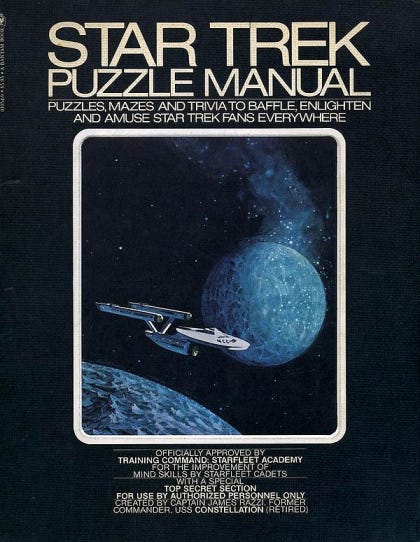
Recently, I got it under my skin to pay it forward, as it were, to create something akin to the STPM.
But I didn’t want any of the puzzles in my offering to be simplistic to the point of being silly. You can (and probably should) get away with that for a puzzle book in the Star Trek universe. For the STPM, what’s the harm in having some fill-in-the-words tasks based on episode titles, or “remember the visual details” tasks based on pictures of a Mugato, or Sulu and Checkov entering the Bridge?
But for something of my own, and especially for modern tweens (and older) who are far more sophisticated than tweens of the mid-70s, those sorts of tasks won’t do.
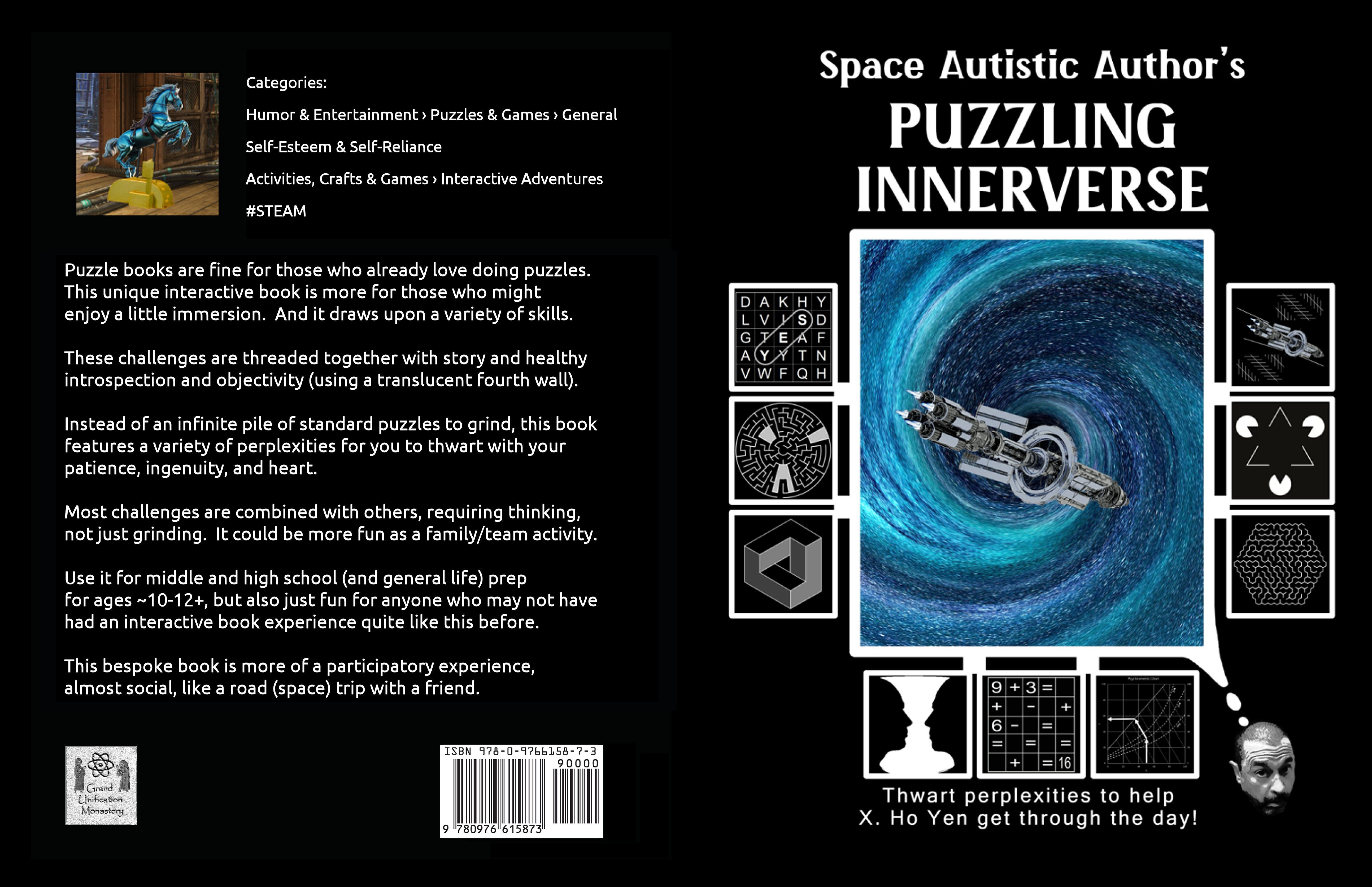
Here’s the currently envisioned cover design (front at right, back at left). There’s nothing on the spine, because the spine is small. There are 80 pages of content.
Despite that ‘a’ word in the title, this book’s intended audience is NOT just autistic kids.
You can see that I was visually inspired by the STPM. No way around it.
As for content, I’m hoping the back cover blurb is reasonably explanatory. And the “marquee title” I’ll use on this book’s page on my web site:

Let me expound a bit.
There are 44 pages of perplexing challenges for the reader, young and old alike, but mainly intended for 10-12+. Some challenges are fairly straightforward, some are a combination of smaller challenges. Each challenge makes sense in the context of the in-world situation. This isn’t just a collection of busy-work puzzles. The world is full of those, especially now that people are using AI to generate them.
No, my Puzzling Innerverse is bespoke. And the more you immerse yourself in this, the more fun it will be.
The reader is immersed in X.’s world, which looks like X. flying through space in the “Endoprise” along with the various embodied voices in his head. (This is an extension of the Innerverse of my cross-promo youtube video series for adults, “Space Autistic Author”.) It can be bizarre, funny, and scary in there. Each challenge is a representation of one of X.’s challenges in his Innerverse. This is stated openly. The fourth wall is translucent here, which is a mechanism for facing introspection, objectivity, and emotional health.
Some of the challenges might seem daunting at first. That’s part of the goal here. If you can get over your fear and actually take a whack at these challenges, you will discover that you can do more than you thought. But I ease into the more challenging tasks, and I alternate between the ‘easy’ end of the spectrum and the ‘daunting’ end. The whole idea is to present these tasks as analogous to real life challenges. Life can be seen as a series of puzzling challenges, perplexities to thwart with the same skills you use in school and in beating the challenges in this book.
And thwarting the larger, combo challenges then provides a great sense of satisfaction, much more than compared with five pages of abstract grind puzzles, plus maybe even a sense of collaboration. (especially if this book is done as a team)
Also, the answers/solutions are usually more than simply “here’s the answer”. They remain in-story, and they include discussion, thanks, and encouragement.
It’s fun to thwart perplexities that require thinking, patience, and focus, not merely grinding, especially since they aren’t abstract exercises. Each task is part of the story.
There’s more to it. In these pages, X. is vulnerable with his frame of mind. He asks for the reader’s help. He even grows over the course of the “day” depicted in this book. The reader is along for the ride, “flying” through X.’s Innerverse with him and his ‘crew’, and maybe, just maybe learning and growing along the way, too.
I could have made this book longer. I could have filled it with more puzzles. But this structure and length felt organically correct. Unlike with a ‘puzzle book’, with something like this you don’t actually want to feel like it’s endless. You participate in the story, you put your hours into actually doing the sometimes complex tasks, you feel the satisfaction of not only getting past fear and of learning, but of helping. And then X.’s day is done, and you helped make it happen. You helped bring completion and closure to the day’s challenges. It feels good, not burdensome. That, too, is intentional.
As I write this, volunteers are graciously evaluating the first draft.
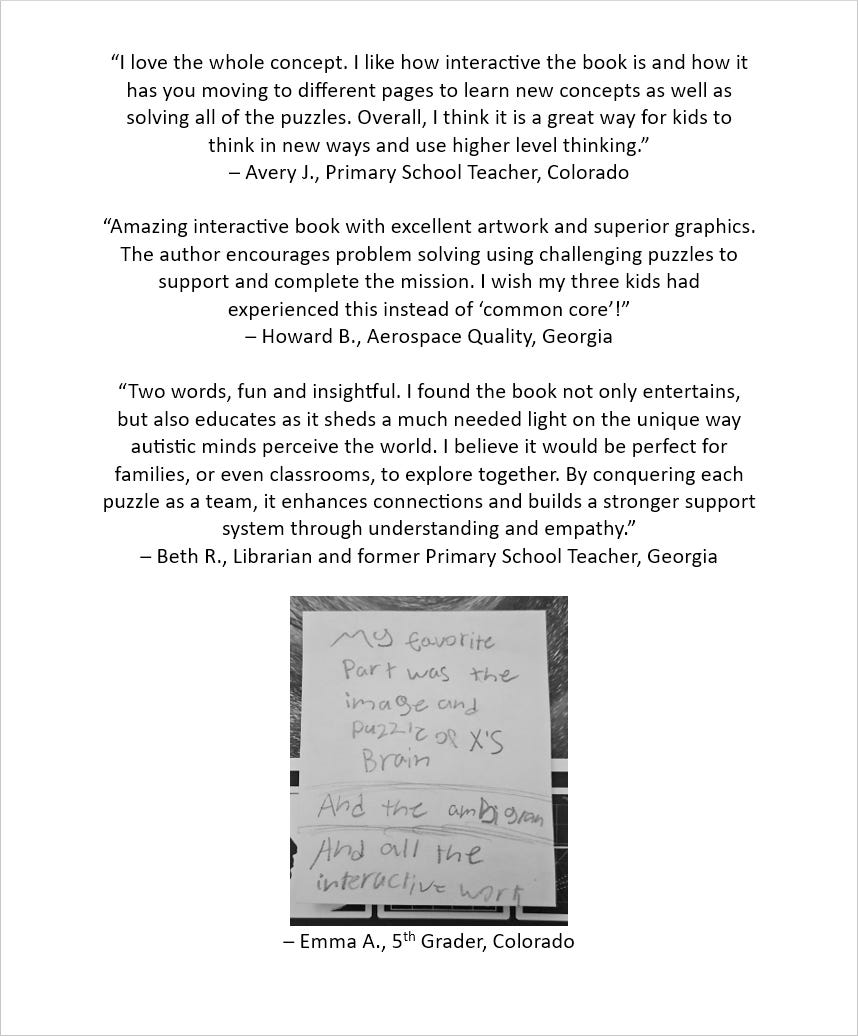
UPDATE: evaluations are in, and all but one ended up on the first page of the book, right inside the cover:
The outlier evaluation was by an adult who expected and wanted a puzzle book, so the gist of that one was “I get the idea of this, but it isn’t for me”. But that evaluation did include valuable information about a section with instructions I’d made more difficult than they needed to be, so it was still valuable.
If this sounds interesting, or if you know anyone who might be interested in this, please point them to my web site (XHoYenAuthor.com) and suggest they subscribe to my newsletter. That’s how everyone will find out when this book is available.
Look for the DISCOUNTED DIRECT PURCHASE links for all my books. Enjoy! :)
Check out this book's page to see the astonishingly good review and associated award by Literary Titan: https://XHoYenAuthor.com/saa-pi